
Read the Allen County Property Tax Record
Allen County property tax records divide responsibility among the PVA, Sheriff, and County Clerk. The PVA assesses property at 100% fair cash value as of January 1 and maintains parcel and exemption data. The Sheriff collects current bills. After delinquent certificates are transferred, the Clerk administers the delinquent-tax process.
| Field | What It Shows | Where |
|---|---|---|
| Assessment | January 1 fair-cash-value assessment | Allen County PVA |
| Land / improvements | Components used to describe and value the parcel | PVA record |
| Exemption | Qualifying reduction in taxable assessment | PVA |
| Current bill and payment | Amount billed and collection status | Allen County Sheriff |
| Delinquent certificate | Unpaid bill transferred for sale administration | County Clerk |
A sale price and an assessment are not rivals. Consideration is the amount reported in a transfer, while the assessment is the PVA's value conclusion for a tax date. The bill then layers on state, county, city, school, library, health, extension, fire, and other applicable district rates. Each number answers a different question.
January 1 Controls Allen County’s Tax-Year Owner
Ownership is keyed to January 1. The roll reflects whoever held title that day. A buyer closing later may appear as "c/o," may not appear at all, or may see the former owner's name stay on the bill until the next calendar year. That lag is normal. It follows from the assessment date, not from a broken chain of title. Check a recent sale against the latest recorded deed through the Allen County deed records. The deed governs the newer transfer. A mailing address can also differ from the situs without changing which land the account covers.
Look Up an Allen County Assessment and Tax Bill
Start with the PVA search by address, owner, or map number. Carry the exact PIN to the collecting office. Rather than guess at an online status, call the Sheriff for the current balance and payment confirmation. The parcel number ties the two lookups together.
- Identify the parcel, tax year, owner carried on the roll, and PIN through the PVA.
- Ask the Sheriff for the current bill, balance, and payment status.
- Confirm assessment and exemption questions with the PVA, which does not set rates or collect bills.
- If delinquent, check the Clerk’s certificate and sale materials.
- Assessed value
- The PVA’s value for the applicable tax date.
- Levy or rate
- The rate imposed by each applicable taxing district.
- Homestead exemption
- A qualifying reduction in assessment, not proof of title.
- Tax lien
- A claim arising from unpaid property tax.
Allen County Homestead and Disability Exemptions
Exemptions change the tax math, not the title. Per the PVA FAQ, homestead eligibility requires a claimant over age 65. The disability exemption requires proof of total disability and qualifying payments throughout the year. Supporting documents may include a Medicare card, birth certificate, driver license, and disability paperwork. The county and city reduction runs $46,350. Confirm the current amount before filing. The PVA forms page carries Form 62A350 for homestead or disability claims, Form 62A023 for nonprofit and religious property, and tangible-property forms. An exemption alone proves nothing about occupancy or ownership.
Why One Allen County Bill Contains Several Rates
One bill can carry many rates. State, county, city when applicable, school, library, health, extension, and fire districts may all act on a single parcel's total. Location drives the difference. Two parcels with similar assessments can still owe different amounts. A Scottsville mailing address does not settle city taxation either. ZIP 42164 also serves rural territory. Use the PIN and map location to identify the applicable districts. Send valuation questions to the PVA. Send rate or payment questions to the collecting office. That keeps an Allen County property search from landing at the wrong counter.
From Sheriff Collection to Allen County Delinquent Certificates
Unpaid bills slip into delinquency quickly. At that stage the County Clerk takes over. The Clerk delinquent-tax page posts local instructions, registration material, certificate lists, and sale timing for Allen County. A 2026 sale calendar appears there. A $30-per-certificate addition also appears. Follow the current posted schedule instead of carrying a prior year forward. The official Allen County delinquent-tax page is the place to confirm each step before you bid.
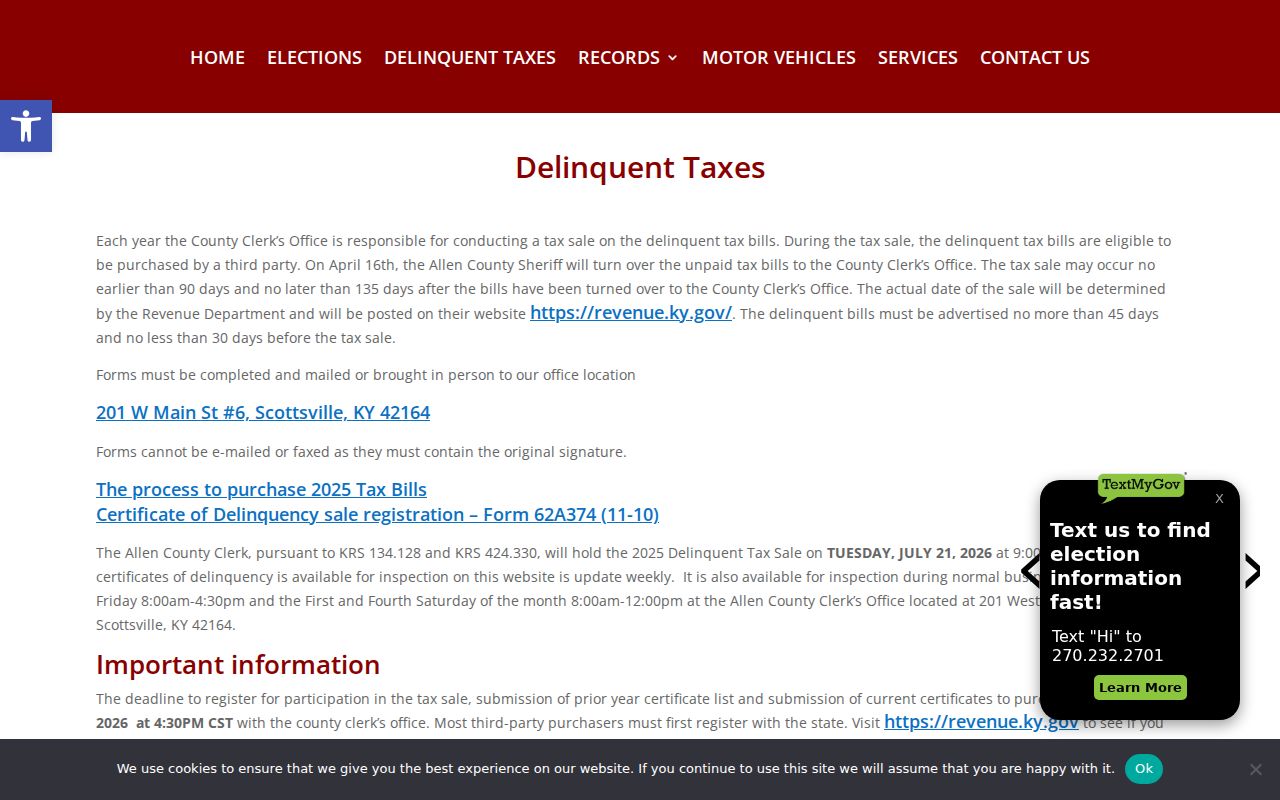
Rely on the current-year documents. Registration, deadlines, and certificate status live there, not in an older saved list. A delinquent list is only a lead. It is not a title certificate, and the Clerk does not research assignments, bankruptcy effects, or other title conditions. Match bill year, taxpayer, address, and map code. Then review the deed and any related court filings before drawing conclusions.
Note: Confirm a delinquent certificate with the Clerk because payment, withdrawal, or litigation can change a published list.
Allen County Reviews Property on a Four-Year Cycle
The PVA duties page sets a physical review at least once every four years. Valuation uses market, cost, and income approaches. Comparable neighborhood sales may inform the result. Even so, parcels do not move on one shared schedule or by one shared percentage. Compare like properties. Review each piece separately. Land value, improvement characteristics, reported sale consideration, and assessment year are distinct facts. The PVA defines the assessment-sale ratio as assessed value divided by sale price, but no official countywide ratio applies mechanically to every parcel.
Appeal an Allen County Real-Estate Assessment
Appeals start in May. The PVA appeal process opens with an inspection period. A conference must be requested within the statutory 13-day window. Bring the property record. Photographs, measurements, comparable sales, repair evidence, and similar facts speak directly to valuation. An unresolved conference goes to the local Board of Assessment Appeals. That step requires the official form and its deadline. Further review runs through the Kentucky claims process. Do not wait for the bill to question a value. Read the assessment notice and PVA record early. Separate factual errors from disagreements over market judgment. Preserve the conference date and everything submitted.
Appeal window. The Allen County conference must be requested during the May inspection period’s 13-day window. Verify the current calendar with the PVA before relying on a date.
Build a Complete Allen County Tax-Year File
Keep tax papers sorted by year. Owner of record, assessment, exemptions, district rates, and payment status can each shift on their own schedule. So bundle the PVA parcel number and assessment notice with the Sheriff's payment confirmation. Include any Clerk delinquent-certificate reference too. A recent sale adds one more piece: file the latest deed. The January 1 owner may differ from the later buyer.
Settle the facts before arguing about value. Look at acreage, land classification, improvement type, and square footage. Confirm that any demolition, addition, or parcel split has actually reached the tax roll. Hand the PVA a document or photograph that pinpoints a concrete error. Simple unhappiness with an amount carries far less weight than evidence tied to the valuation date.
Comparable sales demand the same discipline. Match location, use, land size, improvement features, and the conditions of each sale. A quitclaim, family transfer, or estate conveyance rarely offers the market evidence of an arm's-length transaction. The PVA's market, cost, and income approaches may also weigh the evidence differently depending on the property.
Exempt property needs its own paper trail. Save the filed form and the proof behind the exemption. A homestead or disability reduction affects assessment treatment only. It is never conclusive evidence of who holds title. Tangible personal property runs on separate annual forms. Do not try to read business assets out of a real-estate parcel.
Route payment questions to the right desk. The PVA cannot take a current tax payment. The Sheriff's role with current bills ends where the Clerk's administration of delinquent certificates begins. Asking the correct office prevents the classic mistake of reading an assessment search as a paid receipt.
Send Each Allen County Tax Question to Its Custodian
Send each question to its custodian. The PVA handles ownership, maps, characteristics, valuation, and exemptions. The Sheriff handles the current bill, balance, receipts, and payments. Delinquent certificates and sale registration belong to the County Clerk. Assignment material and the posted delinquent list also sit with the Clerk. Litigated liens or foreclosures call for the official court file as a supplement.
Include the parcel number, tax year, and taxpayer name in every contact. For a correction, name the disputed field. Attach the deed, survey, photographs, or measurements that support the change. For copies under open records, rely on the PVA's form or the Clerk's policy. Not every internal working note appears on qPublic.
Dates deserve close attention. A tax record reflects one assessment date and billing year. A deed records a transaction date. Payment status moves as collection proceeds, and a delinquent list can change before a sale. Noting those dates beside each source keeps a newer fact from being compared against an older snapshot as if they showed the same moment.
Allen County property tax records serve valuation review and payment verification. They also support sale due diligence and civic transparency. Use them lawfully and with respect for protected information. An official tax record never authorizes harassment. A published address is not proof of where a person lives today.